
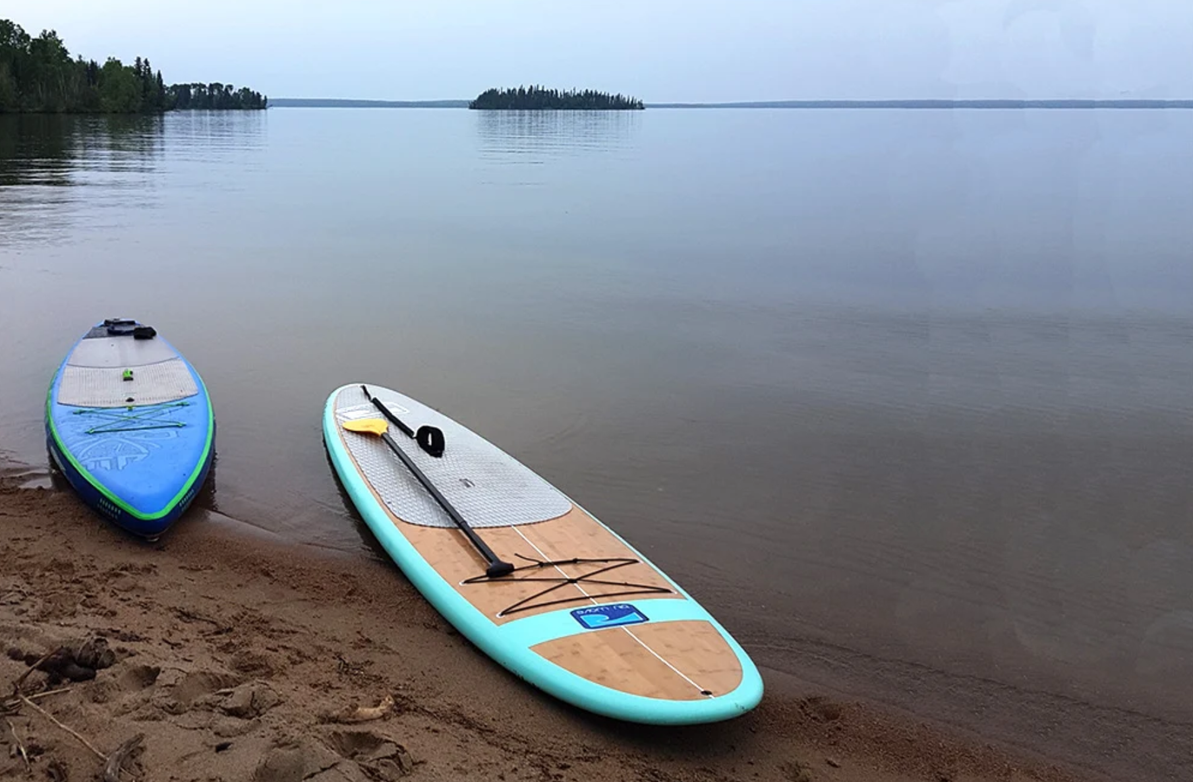
What to Choose: Inflatable SUP vs Hard SUP
When to Choose an Inflatable or Hard Paddle Board
Choosing between an inflatable and hard paddle board is one of the first decisions you'll need to make when buying a SUP. Both can be excellent options, but they offer different advantages when it comes to performance, storage, transportation, durability, and cost.
For many recreational paddlers, a quality inflatable SUP provides more than enough performance while being significantly easier to transport and store. Hard boards, however, still have an advantage for paddlers who prioritize speed, responsiveness, surfing, or high-level performance.
Understanding the differences in the inflatable SUP vs hard board debate can help you choose a board you'll actually enjoy owning and using.
Key Takeaways
- Inflatable SUPs are easier to store and transport, making them practical for travelers, apartment owners, and casual paddlers
- Hard paddle boards generally offer better responsiveness, performance, and glide.
- The performance gap can be relatively small for recreational paddling, with a controlled comparison found a hard board was roughly 5-6% faster than a similarly sized inflatable board used with the same amount of effort.
- Inflatable boards tolerate day-to-day wear and tear, but can be damaged by sharp objects, seam problems, or valve failures.
- Hard boards cannot puncture, but their fiberglass or epoxy shells can dent, chip, or crack when dropped or struck by something.
- Both inflatable and rigid boards require maintenance
- A well made inflatable can be a much better purchase than a poorly constructed hard board, and vice versa
Inflatable SUP vs Hard SUP
If convenience is your biggest priority, an inflatable board is usually the better option. You can deflate it, pack it into a bag, put it in a car trunk, and store it in a closet when you are finished.
If performance is your biggest priority, a hard board will generally have the advantage. Its rigid construction and shaped hull allow it to glide more efficiently and respond more precisely to the rider's paddling.
However, modern inflatable construction has improved considerably. For casual paddling, beginners, families, fitness paddling, and many touring applications, the difference may be much less noticeable than people expect.
The right choice ultimately depends on what kind of paddling you want to do, how you will transport your board, and how you will store it.
SUP Inflatable vs Hard Board Performance
Performance is one of the biggest differences when comparing an inflatable SUP to a hard board.
Hard boards have a solid structure that allows manufacturers to shape the nose, rails, bottom, and tail more precisely. This can improve glide and reduce resistance through the water. They also tend to feel more responsive when turning or maneuvering.
Board thickness, weight, and wind exposure can all affect how an inflatable performs compared with a rigid board. Inflatables are typically thicker than rigid boards, with many measuring around 6 inches, which helps provide rigidity but also places more of the board above the water. This higher profile can make an inflatable more susceptible to crosswinds and require more effort to maintain a straight course in windy conditions. Rigid boards generally sit lower in the water and have more refined hull shapes, which can provide better tracking, glide, and efficiency while paddling. Weight also plays a role, but it should not be viewed in isolation: while inflatables are often lighter than comparable rigid boards, their construction, flex, hull shape, and increased wind exposure can make them less efficient to paddle than a rigid board, particularly at higher speeds or over longer distances.
Inflatable boards rely on internal drop-stitch construction and air pressure to create rigidity. Higher-quality inflatables can become impressively stiff when inflated to the manufacturer's recommended PSI, but they still don't behave exactly like a solid composite board. Inflatable boards rely on internal drop-stitch construction and air pressure to create rigidity. Higher-quality inflatables can become impressively stiff when inflated to the manufacturer's recommended PSI, but they still do not behave exactly like a solid composite board. PSI and temperature can also affect performance: lower pressure can increase flex and reduce efficiency, while heat can increase internal pressure and make the board feel firmer. For the most consistent performance and to avoid unnecessary stress on the seams and materials, inflatables should be inflated to the manufacturer's recommended PSI and monitored when exposed to significant heat or direct sunlight.
How significant is the difference?
In a controlled speed test conducted by ISLE Paddle Boards, a 12'6" inflatable touring board averaged 3.78 mph at a relaxed pace, compared with 3.96 mph for the hard board. At a higher-intensity pace, the inflatable averaged 4.88 mph, while the hard board reached 5.21 mph. This represents approximately a 5–6% speed difference in that particular comparison. [Source: ISLE Paddle Boards, “Inflatable vs. Hard Paddle Boards: A Speed Comparison.”]
For someone casually paddling around a lake or the Intracoastal, that difference may not matter much at all. Over a long-distance race, however, even a few percent can become significant. The gap can also become larger with specialized race boards. Narrow, shaped hard boards can achieve performance that is difficult for an inflatable design to replicate.
So, rather than thinking of every hard SUP as being dramatically faster, consider the type of board. A recreational hard board and premium inflatable may perform fairly closely, while a dedicated carbon race board and an all-around inflatable are in completely different categories.
Inflatable vs Hard SUP for Different Types of Paddling
Your preferred activity should also influence your decision.
Recreational and Beginner Paddling
Both inflatable and hard boards can work well for beginners, but they offer different advantages.
Inflatable SUPs are popular with new paddlers because they are often wide, stable, and easy to transport. Their slightly softer construction can also feel more forgiving if you fall onto the board while learning.
Hard boards can be equally beginner-friendly when you choose a wide, stable all-around shape. They typically feel more rigid underfoot and respond more immediately to paddle strokes, which can help beginners develop better board control. They also require no setup time, so you can unload the board and get straight onto the water.
Touring
Both constructions are available in touring-specific shapes designed to improve tracking and efficiency over longer distances.
Inflatable touring boards offer the major advantage of portability. A longer touring SUP can still be deflated and packed into a relatively compact bag, making it much easier to travel with than a similarly sized hard board.
Hard touring boards generally have the performance advantage. Their rigid construction and more precisely shaped hulls can provide better glide, tracking, and efficiency. Over several miles, that improved efficiency can mean fewer paddle strokes and less effort to maintain the same pace.
Racing
Hard SUPs are generally the preferred option for serious racing.
Manufacturers can shape a hard board's hull, rails, nose, and tail much more precisely than they can with an inflatable. Combined with greater rigidity, this allows performance-oriented hard boards to reduce drag, hold speed, and transfer power efficiently with each paddle stroke.
Inflatable race boards have improved significantly and can still be very fast. Their biggest advantage is transportation, particularly for paddlers flying to races or competing in locations where transporting a 12'6" or 14' hard board would be difficult.
However, when outright speed is the priority and transportation isn't an issue, a dedicated hard race board will usually outperform an inflatable equivalent.
SUP Surfing
The difference between inflatable and hard boards becomes more noticeable when SUP surfing.
Hard surf SUPs can be shaped with thinner rails, specific rocker profiles, and more refined bottom contours. This gives them better edge control and allows them to respond more quickly when carving, turning, or moving across the face of a wave. Their rigidity also provides a more direct connection between the rider and the board.
Inflatable boards can still be fun in smaller waves and are a practical option for someone who occasionally surfs but primarily uses their SUP for recreational paddling. Their softer construction can also be a little more forgiving during falls or crowded sessions.
Yoga, Families, and Casual Use
Inflatable SUPs are particularly popular for yoga and family use because their wider shapes and softer surfaces create a comfortable platform for kneeling, sitting, stretching, or bringing children and pets aboard.
Hard boards shouldn't be ruled out, though. A wide hard all-around SUP can provide excellent stability and an especially solid platform for yoga or casual paddling. Because the board doesn't flex under weight, some paddlers may prefer the more planted feeling of a rigid board when balancing or moving between yoga positions.
Hard boards are also convenient for frequent paddlers who can store them near the water. There's no inflation or deflation required, which makes spontaneous paddling much easier.
For families or paddlers with limited storage, an inflatable is generally easier to manage. For someone with garage storage, a roof rack, or waterfront access, a hard board can be just as practical while providing a more rigid and responsive ride.
Travel and Accessibility: Inflatable or Hard Paddle Board?
This is where inflatables have one of their biggest advantages.
A deflated inflatable SUP can fit into a backpack-style carrying bag. That means it can go in a sedan, SUV, RV, boat locker, or even on an airplane without needing a roof rack. A hard SUP measuring 10 to 14 feet obviously requires more planning. You'll generally need a suitable vehicle or roof-rack system, and moving the board from your home to your vehicle and then down to the water takes more effort.
Storage matters too. If you have a garage with a wall or ceiling rack, storing a hard SUP may not be an issue. If you live in an apartment or condominium, finding somewhere to put an 11-foot board can become a much bigger problem.
The tradeoff with an inflatable is setup time. Most inflatable paddle boards take around 10–15 minutes to inflate by hand, while a quality electric SUP pump can often have the board ready in roughly 5–10 minutes. You’ll also need to attach the fin and prepare your paddle and other equipment before launching.
Inflatable SUPs require a high-pressure SUP pump to reach their recommended PSI, which is commonly around 12–15 PSI but varies by board. Most inflatable SUPs include a suitable hand pump, so you don’t necessarily need to purchase additional equipment. A standard low-pressure pump designed for pool floats or air mattresses usually will not provide enough pressure. An electric SUP pump is optional, but it can make setup significantly easier, especially if you paddle frequently.
With a hard board, there’s no inflation process. You can essentially unload it, attach your leash, grab your paddle and head for the water.
How Fragile Are Paddle Boards?
There's a common misconception that inflatable boards are fragile because they're filled with air. In everyday use, the opposite can sometimes appear true. A quality inflatable SUP made from reinforced PVC can tolerate bumps against docks, vehicle interiors, and other objects without developing the type of surface ding you might see on a composite board. The biggest risks to inflatables are sharp objects, dragging the board across abrasive surfaces, valve problems, and seam damage.
Hard boards have a foam core surrounded by fiberglass, epoxy, carbon fiber, or another composite construction. They're strong on the water, but a concentrated impact can damage the outer shell. Dropping the board onto concrete, hitting a dock, or striking the rail against something hard can cause pressure dents, chips, cracks, or dings. A small cosmetic pressure dent may not affect performance. A crack that penetrates the shell is different because it can allow water to reach the foam core. Those repairs should generally be addressed before the board goes back into the water. This means hard boards aren't necessarily "fragile," but they usually require more care while loading, unloading, transporting, and storing them.
Cost of Inflatable vs Hard SUP Ownership
Initial price varies enormously in both categories. Entry-level inflatable SUP packages typically start around 300–500, while higher-quality recreational and touring inflatables often fall in the 500–1,500 range. Premium inflatable touring, racing and other specialist boards can reach 1,500–2,000 or more. Hard paddle boards generally start higher, with recreational models beginning around 500–800, while quality fiberglass and performance boards commonly cost 900–1,500. Specialist carbon touring and race boards designed for advanced or competitive paddlers can exceed 2,500–3,000.
Don't judge quality purely by whether the board is inflatable or rigid. There are also repair costs to consider. A relatively simple ding on a hard paddle board may cost somewhere around 50–100 to repair professionally, depending on your area. Larger structural repairs, damaged fin boxes, delamination, or major rail damage can cost several hundred dollars.
Inflatable repairs also vary considerably. Small punctures may be inexpensive or possible to patch yourself with the correct repair kit. Professional repairs involving valves, difficult leaks, or seams can cost substantially more. A valve replacement or leak repair may range from roughly $60 to $200, while significant seam failures can become expensive enough that replacing an older or inexpensive board makes more financial sense.
Repair prices vary by shop, board construction, and damage, so these figures should be treated as general examples rather than fixed prices.
How to Choose a Quality Inflatable Paddle Board
Not all inflatable SUPs are built to the same standard. Look beyond the graphics and included accessories. Construction quality is much more important. A good inflatable should use quality drop-stitch construction to help the board maintain its shape under pressure. Reinforced or welded rail construction can improve durability, while the recommended operating PSI can give you an indication of how the board is designed to achieve rigidity. Also consider the quality of the valve, fin box, deck pad, seams, handles, and included pump. A reputable manufacturer should clearly provide weight capacity, dimensions, recommended pressure, construction information, and warranty coverage.
Extremely cheap inflatable packages can be tempting, but poor seams, flexible construction, low-quality accessories, and inaccurate weight capacities can quickly make the initial savings less worthwhile.
How to Choose a Quality Hard SUP
With a hard board, start with its intended purpose. A wide all-around board will prioritize stability, while a longer and narrower touring board will generally prioritize tracking and glide. Surf SUPs will have different rail and rocker profiles, while race boards are designed almost entirely around efficiency and speed. Pay attention to construction materials, board weight, fin system, deck pad quality, volume, and weight capacity. You should also inspect a hard board carefully before purchasing. Look for cracks, soft areas, major pressure dents, damaged rails, or previous repairs if the board isn't new.
Whenever possible, choose a board from a reputable manufacturer that provides clear construction specifications and support.
You can also browse our SUP boards to compare inflatable and hard paddle boards for different riding styles.
Inflatable SUP vs Hard: Pros and Cons
|
Board Type |
Pros |
Cons |
|
Inflatable SUP |
Easy to transport, compact storage, travel friendly, durable against everyday bumps, comfortable deck, good for beginners |
Requires inflation, must be dried before storage, potential punctures or seam leaks, slightly less responsive, generally slower than comparable performance hard boards |
|
Hard SUP |
Better glide, excellent rigidity, more responsive, better for racing and surfing, no inflation required |
Requires substantial storage space, harder to transport, can ding or crack from impacts, often needs roof racks, composite repairs can become expensive |
Frequently Asked Questions
Is an inflatable or hard paddle board better for beginners?
For many beginners, an inflatable is the most convenient choice. Quality inflatable SUPs are stable, relatively forgiving, easy to transport, and don't require a large storage area. A stable hard board can also be an excellent beginner option if transportation and storage aren't concerns.
Are hard paddle boards much faster than inflatable boards?
Not necessarily for normal recreational use.The performance difference can become more significant with specialized touring and race boards, where hull shape and rigidity matter considerably more.
Do inflatable paddle boards puncture easily?
A quality inflatable SUP is designed to withstand normal recreational use and isn't comparable to a pool float. Reinforced PVC can tolerate substantial everyday abuse. Sharp rocks, glass, dragging across rough surfaces, and other concentrated damage can still cause punctures.
Do inflatable paddle boards get moldy?
They can if they're repeatedly packed away wet. Rinse the board when necessary and allow it to dry completely before long-term storage. Keeping the board and carrying bag in a clean, dry environment reduces the risk of mold and mildew.
Are hard paddle boards easy to damage?
Hard boards are durable enough for normal paddling but can develop dents, chips, and cracks from concentrated impacts. Take additional care around concrete, docks, vehicle racks, and other hard surfaces.
Which lasts longer, an inflatable or hard SUP?
There isn't one universal answer. Construction quality, maintenance, storage, frequency of use, UV exposure, and accidental damage all influence lifespan. A premium inflatable that's properly maintained can outlast a poorly cared-for hard board, while a quality composite SUP can remain usable for many years when protected from major impacts.
Should I buy an inflatable or hard paddle board?
Choose an inflatable if portability, travel, and compact storage are your biggest priorities. Choose a hard board if maximum glide, responsiveness, surfing performance, or racing performance matters more than convenience.
For many recreational paddlers, a quality inflatable offers the best combination of practicality and on-water performance. For performance-focused paddlers with sufficient transportation and storage space, a hard SUP remains difficult to beat.
Recent Posts
-
SEABOB F9 vs F9S: Specs, Price & Which to Buy
SEABOB F9 vs F9S: Which One Belongs in Your Water Toy Lineup? We've been selling water toys out o …17th Oct 2026 -

What to Choose: Inflatable SUP vs Hard SUP
When to Choose an Inflatable or Hard Paddle Board Choosing between an inflatable and hard paddle boa …26th Aug 2026 -

Choosing the Best Paddle Board Size for You
Choosing the Best Paddle Board Size for You Choosing a stand-up paddle board is about more than jus …20th Aug 2026